

What Do Marks on Stones Have to Do with Business Decisions? From 1831 to 1993, British surveyors used carved symbols in stone, like the one in the photo, to mark topographical heights and distances across the country. These reference points, known as “benchmarks,” were essential for measuring, planning, and building vital infrastructure such as roads and railways, which contributed to the accelerated development of the Kingdom and its global leadership in the 19th and 20th centuries.
Today, “benchmarks” have been extrapolated to the business world, playing a crucial role in identifying performance gaps, setting goals, prioritizing improvements, and overall decision-making. For example, they allow companies to assess whether their production costs or service prices are at an appropriate level. Even for industry-leading companies, benchmarks help identify which aspects of the business are at the forefront and prioritize areas for focused improvement efforts.
In the mining industry—whether copper, gold, or coal—several firms publish the production costs of many operations and establish curves where the lowest-cost producer per ton sets “the mark,” the benchmark.
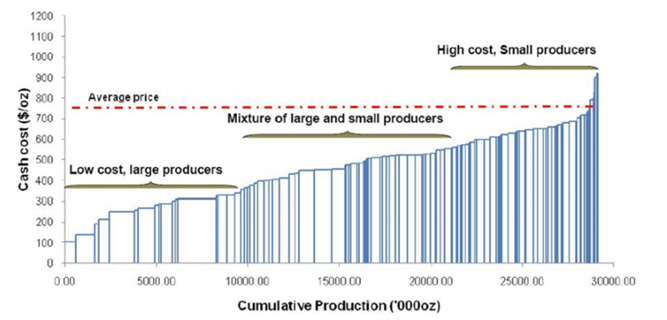
At the same time, this tool suffers from the pitfalls of its own success: it is often used to make decisions far beyond its intended purpose. For example, a benchmark of “SG&A” expenses (a line in the summarized Income Statement) across companies in the same industry could be used without further analysis to reduce administrative staff—without knowing whether the concept of SG&A is exactly the same in all companies. Some include expenses in SG&A that others account for as operational costs; some include foreign trade expenses that others consider as deductions from revenue. Given the appeal of this tool, the temptation to misuse a benchmark is high.
At Montblanc, we also use benchmarks as a tool to help diagnose various aspects of a business and set improvement goals. However, we find it crucial to understand that a benchmark is just one of the tools available in a broader set, which includes understanding customer needs, reviewing practices, mapping processes, measuring structural effectiveness, among others.
So, here we propose some best practices to make the most of this valuable analytical tool:
- Clearly establish the purpose of the benchmark: What decision does it serve? It’s important to use the benchmark for the specific purpose for which it was designed. Different types of benchmarks have different objectives and scopes.
- Choose the measurement and scope of comparison that are consistent with the decision to be made: A poorly defined benchmark can lead to significant errors. For example, when comparing production costs of salmon farming companies, it’s essential to consider differences in processes and practices that could affect the results. While benchmarks can also be applied to qualitative aspects, it’s more effective to translate them into quantitative measurements to get a clearer view of the gaps.
- Assimilate comparables “Ceteris paribus” (all other things being equal): For a benchmark to be relevant, it is crucial to compare similar situations. Not all companies account for their revenues and costs in the same way, so it is essential to analyze equivalent data to draw accurate conclusions.
- When analyzing the results, seek the reasons for the differences: In benchmarking unit costs, we analyze differences by asking questions about inherent business factors—such as size/scale, or users with different requirements, systemic factors—another example is recent investment in automation, and operational factors or how people in the area are organized. This helps us pinpoint the “why” behind the differences between one company and another.
- Combine with other measurements: The benchmark is a powerful tool, but it should be complemented with other analyses to make informed decisions. By combining it with other data, a more complete picture of the situation is obtained, and erroneous decisions are avoided.
As a firm, we apply these same practices in a broader case: we regularly invite large companies in the region, from various industries, to participate in the largest and most precise benchmark of back-office process efficiency. We successfully separate certain efficiency and productivity factors and quantify the effects of economies of scale for key back-office processes such as payroll, customer billing, and vendor payments.
In summary, benchmarks are useful tools within the set of analyses and goal-setting process for improvement. However, their correct use and combination with other measurements are essential to making informed decisions and maximizing their potential in the business world.